In brief
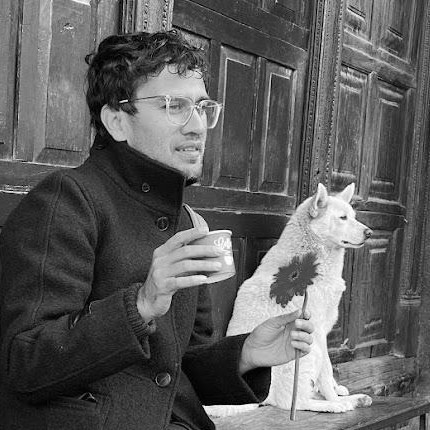
Theoretical physicist, educator, writer.
In the first moments of the universe, particles collided at energies no accelerator can reach. I study those collisions, and sometimes their counterparts in holographic spacetimes. I also work on quantum magic, the resource that makes some quantum states hard for classical computers to simulate. More recently, I have taken up primordial black holes and other compact objects. Closer to the classroom, I study how humans, and students in particular, learn now that AI gives instant answers. And I think deeply about energy and energy policy: every society runs on it, yet few people know the numbers.
Teaching Physics for Future Presidents keeps me asking how science enters policy debates and how to give future decision-makers enough physical intuition to tell a sound argument from a weak one.
Outside physics, I swim in open water. On Tuesday evenings I sit in silence with the Williamstown Zen Group, led by my friend Bernie Rhie, whose Chicago sangha I host.
Lines of inquiry
Scattering amplitudes and cosmology
Much of what we know about quantum field theory in flat space has been reorganized around scattering amplitudes, with recursion relations, the double copy, and hidden symmetries replacing page-long Feynman-diagram computations. Principally with my longtime collaborator and friend Soner Albayrak, I have helped extend these methods to anti–de Sitter and de Sitter space: higher-point gluon and graviton correlators in momentum space, color–kinematics duality in (A)dS, loop-level amplitudes, Mellin amplitudes for many gluons, and soft limits that connect holography and cosmology. In de Sitter space these correlators describe the primordial statistics later imprinted on the cosmic microwave background and the large-scale structure of the universe; in anti–de Sitter space they are the observables of holography. Our 2026 review surveys the field.
Magic and quantum information
Quantum computation distinguishes states that are classically simulable from those that are not; the resource separating them is called magic. Jinwei Chu, formerly a graduate student at Chicago and now at the University of Barcelona, and I introduced a phase-independent formulation of the stabilizer Rényi entropy and used it to measure magic in gluon scattering. I am interested in magic more broadly, and further work with several collaborators is in progress.
Strings and compact objects in cosmology
I am working on string stars, bound states of highly excited strings, and their connection to the formation of primordial black holes.
The physics of learning
With Carl Wieman and other colleagues in physics education, I am studying how students learn physics and how AI is changing that. A chatbot will now hand a student a clean, correct solution to most homework problems. What disappears are the decisions where the learning happens: which principle applies, what can be neglected, and whether the answer makes sense. The influence runs both ways: what we know about expert problem-solving and metacognition can shape how AI tutors and assignments are designed, so that these tools build students’ thinking rather than replace it.
Selected publications
For the full list, see Google Scholar, INSPIRE, or ORCID.
- 2026 Cosmological correlators from scattering amplitudes: a review with Soner Albayrak — arXiv:2609.19252
- 2026 Magic without a phase: phase-independent stabilizer Rényi entropy in gluon scattering with Jinwei Chu — arXiv:2607.13134
- 2025 Soft limits of gluon amplitudes in holography and cosmology with Soner Albayrak — JHEP 07 (2025) 019 · arXiv:2411.13652
- 2024 Toward the Feynman rule for n-point gluon Mellin amplitudes in AdS/CFT with Jinwei Chu — Phys. Rev. D 109, 106003 (2024) · arXiv:2401.00038
- 2024 Momentum-space formulae for AdS correlators for diverse theories in diverse dimensions with Soner Albayrak and Xinkang Wang — JHEP 07 (2024) 281 · arXiv:2312.02154
- 2024 Mellin amplitude for n-gluon scattering in anti–de Sitter spacetime with Jinwei Chu — Phys. Rev. D 109, L101901 (2024) · arXiv:2311.06342
- 2023 All plus four point (A)dS graviton function using generalized on-shell recursion relation with Soner Albayrak — JHEP 05 (2023) 151 · arXiv:2302.09089
- 2021 On duality of color and kinematics in (A)dS momentum space with Soner Albayrak and David Meltzer — JHEP 03 (2021) 249 · arXiv:2012.10460
- 2021 Spinning loop amplitudes in anti–de Sitter space with Soner Albayrak — Phys. Rev. D 103, 026004 (2021) · arXiv:2006.12540
- 2020 Loop celestial amplitudes for gauge theory and gravity with Soner Albayrak and Chandramouli Chowdhury — Phys. Rev. D 102, 126020 (2020) · arXiv:2007.09338
- 2020 Study of momentum space scalar amplitudes in AdS spacetime with Soner Albayrak and Chandramouli Chowdhury — Phys. Rev. D 101, 124043 (2020) · arXiv:2001.06777
- 2019 Towards the higher point holographic momentum space amplitudes. Part II. Gravitons with Soner Albayrak — JHEP 12 (2019) 135 · arXiv:1908.01835
- 2019 New relation for Witten diagrams with Soner Albayrak and Chandramouli Chowdhury — JHEP 10 (2019) 274 · arXiv:1904.10043
- 2019 Towards the higher point holographic momentum space amplitudes with Soner Albayrak — JHEP 02 (2019) 040 · arXiv:1810.12459
Books & writing
Scattering Amplitudes for Cosmology and Holography (with Soner Albayrak) is a graduate-level text bringing modern amplitude methods to cosmological correlators and holography. It is in preparation for Springer.
Book reviews
- 2024 “The art of cosmic simulations” Review of Romeel Davé, Simulating the Cosmos — Physics World 37(7), 2024
- 2023 “A timely retrospective” Review of Thomas Hertog, On the Origin of Time — Physics Today 76(11), 2023
- 2019 “Electromagnetism textbook bridges the gap between basic and advanced” Review of J. Dirk Walecka, Introduction to Electricity and Magnetism — Physics Today 72(6), 2019
Teaching & mentoring
Teaching is the part of my work I love most. Across the physics curriculum at Chicago, Yale, and Williams, my students have repaid that work many times over with their curiosity and kindness.
What I care about is problem-solving: what a student does when a problem looks like nothing in the textbook. That skill rests on metacognition, the habit of noticing and correcting one’s own thinking, so my classes are built on active learning: students commit to a prediction before they calculate, argue their reasoning with a neighbor, check their answers against limiting cases, and revise when the check fails. They do the thinking rather than watch it.
Learning happens best in a community, and I try to build one at every level: mentoring PhD students, postdocs, and undergraduate researchers, serving on thesis committees, and, since 2023, teaching New York City’s master mathematics and science teachers through Math for America. I am always glad to advise colleagues on teaching, and now and then I talk about it on public forums and podcasts.
Background
- 2021–presentUniversity of Chicago — Associate Instructional Professor
- 2018–2020Williams College — Visiting Professor of Physics
- 2016–2018Yale University — Postdoctoral Associate
- 2015–2016Davidson College — Visiting Professor of Physics
- 2015PhD in Physics, University of Tennessee
For students
Research. I mentor a small number of students each year. If you are highly motivated and have the necessary background, email me a few sentences on what draws you to the work, along with your CV and the courses you have taken.
Recommendation letters. I would love to write for you, but a letter is only effective when I know your work well, so I typically write for students who have taken a full course with me and engaged beyond lectures. Please ask at least four weeks before your first deadline and send a complete packet: CV, statement, transcript, program list, and a few sentences on what you would like me to highlight.
Contact
If any of this overlaps with your own interests in physics, teaching, or writing, I’d be glad to hear from you.
- Office
- Department of Physics, KPTC, 5720 S. Ellis Ave, Chicago, IL 60637